Vol. 25, n. 3, novembre 2026
RICERCHE, PROPOSTE E METODI
Selezione scolastica, credenze meritocratiche e atteggiamenti verso gli studenti plusdotati
Un’analisi di mediazione con insegnanti italiani1
Francesco Marsili,2Maria Mirandi3 e Annalisa Morganti4
Sommario
Il presente studio esamina le relazioni tra gli atteggiamenti degli insegnanti verso l’educazione dei plusdotati (ATGE), le credenze nella meritocrazia scolastica (BSM) e l’adesione alla funzione selettiva della scuola (BSS), attraverso un modello di mediazione testato su un campione di 463 insegnanti italiani in servizio. Le analisi hanno evidenziato che gli atteggiamenti favorevoli verso l’educazione dei plusdotati sono positivamente associati sia alle credenze meritocratiche sia all’endorsement della selezione scolastica. Le credenze nella meritocrazia scolastica fungono da mediatore parziale nella relazione tra ATGE e BSS, suggerendo che il sostegno alla plusdotazione si traduce, in parte, in una più ampia adesione a logiche selettive attraverso la legittimazione meritocratica. Inoltre, gli insegnanti curricolari mostrano livelli significativamente più elevati di BSM e BSS rispetto agli insegnanti di sostegno, riflettendo il diverso posizionamento istituzionale dei due gruppi rispetto alle funzioni valutative e inclusive della scuola. I risultati contribuiscono a chiarire come logiche inclusive e selettive coesistano nel sistema di credenze degli insegnanti e come l’ideologia meritocratica modelli l’interpretazione della plusdotazione e del ruolo dell’istruzione.
Parole chiave
Plusdotazione, meritocrazia scolastica, selezione scolastica, atteggiamenti degli insegnanti, educazione inclusiva.
RESEARCH, PROPOSALS, AND METHODS
School selection, meritocracy beliefs and attitudes toward gifted students
A mediation analysis with Italian teachers
Francesco Marsili,5Maria Mirandi6 and Annalisa Morganti7
Abstract
The present study examines the relationships among teachers’ attitudes toward gifted education (ATGE), belief in school meritocracy (BSM), and endorsement of the selective function of schooling (BSS) through a mediation model tested on a sample of 463 Italian in-service teachers. Results indicated that favorable attitudes toward gifted education were positively associated with both meritocratic beliefs and endorsement of school selection. Belief in school meritocracy partially mediated the relationship between ATGE and BSS, suggesting that support for gifted education is partly translated into broader endorsement of selective schooling logics through meritocratic legitimation. Furthermore, curricular teachers reported significantly higher levels of BSM and BSS than support teachers, reflecting the differential institutional positioning of the two groups with respect to the evaluative and equity-oriented functions of schooling. The findings contribute to clarifying how inclusive and selective logics coexist within teachers’ belief systems and how meritocratic ideology shapes the interpretation of giftedness and the broader purpose of education.
Keywords
Gifted education, school meritocracy, school selection, teacher attitudes, inclusive education.
Introduction
Contemporary education systems face a fundamental tension between inclusive ideals and selective practices. While inclusive education frameworks (UNESCO, 1990; 1994; United Nations, 2006) assert all learners’ right to meaningful participation, non-discrimination and high-quality education, schooling remains organized around competitive, meritocratic mechanisms that rank and reward performance (Batruch, Autin & Butera, 2019; Khamzina et al., 2021; Stanczak et al., 2024). This reflects education systems’ alignment with labor market demands, shaping practices that constrain inclusive principles (Buchner et al., 2021; Florian, 2019; Göransson & Nilholm, 2014; Haug, 2017). Teachers’ beliefs and attitudes function as proximal antecedents of instructional decisions (Batruch et al., 2023; Darnon et al., 2018; Wiederkehr et al., 2015). Belief in school meritocracy — that success reflects individual effort and ability — is associated with lower support for equalizing measures (Batruch et al., 2023; Darnon, Smeding & Redersdorff, 2018). Teachers conceptualizing schooling selectively express less favorable attitudes toward inclusive education (Khamzina et al., 2021; Stanczak et al., 2024).
Gifted education provides a revealing lens for examining these dynamics. Contemporary models emphasize dynamic, contextual conceptions of giftedness (Subotnik et al., 2023), yet gifted education has historically functioned as a selection mechanism reproducing hierarchies (Borland, 2005; Martschenko, 2023; Worrell & Dixson, 2022). Giftedness is «something we confer, not something we discover. It is a matter of educational policy, not a matter of scientific diagnosis. It is a social construction, not a fact of nature» (Borland, 2005, p. 8), yet remains operationalized as essential for cultivating human capital. Gifted education thus occupies a strategic position where selection is operationalized — a critical site for observing how teachers reconcile excellence, equity, and inclusion.
Attitudes toward gifted education encompass beliefs about how talent and differentiation should be understood (Sambuis & Bourdin, 2025). A systematic review revealed that while teachers express positive attitudes toward meeting gifted students’ needs, they demonstrate ambivalence toward interventions removing students from classrooms (Sambuis & Bourdin, 2025). Personal interactions and teacher self-efficacy emerge as robust predictors (Sambuis & Bourdin, 2025), with professional development as a critical factor (Lassig, 2009). Many teachers hold essentialist conceptions viewing giftedness as innate despite developmental models (Ayık, Çetin & Usta, 2025; Gagné, 2018; Mazzoli Smith & Campbell, 2016; Ziegler & Phillipson, 2012). When framed as innate, giftedness legitimizes selective practices aligning with meritocratic worldviews (Borland, 2021; Darnon, Smeding & Redersdorff, 2018). Teachers endorsing selective programs express stronger belief in education as a «merit filter» (Jung & Lee, 2024; Mazzoli Smith, 2013). Cross-national studies reveal variation (Mullen & Jung, 2019), with elitism concerns shaping orientations (Lassig, 2009; Polyzopoulou et al., 2014; Radulović, 2022). Research identifies distinct typologies with predictors including experience and beliefs about intelligence (Giza, 2022; Jung & Lee, 2024; McCoach & Siegle, 2007). Cross-cultural patterns show teachers recognize gifted needs while remaining cautious about segregation (Antoun, Kronborg & Plunkett, 2020).
Belief in school meritocracy (BSM) functions as an ideological lens mediating interpretations of diversity, achievement, and justice (Autin, Batruch & Butera, 2015; Batruch et al., 2023; Darnon, Smeding & Redersdorff, 2018). This reframes structural inequalities as legitimate merit outcomes, reducing support for equity policies while reinforcing competitive evaluation (Darnon et al., 2018; Wiederkehr et al., 2015). Teachers endorsing meritocracy justify hierarchies and show less support for inclusive education (Stanczak et al., 2024). BSM may bridge attitudes toward gifted education and endorsement of selection: when teachers view giftedness meritocratically, they perceive inequality as fair. Essentialist beliefs about talent correlate with endorsement of selective practices (Ayık, Çetin & Usta, 2025), suggesting support for gifted education can reinforce selective orientations prioritizing excellence over equity (Batruch, Autin & Butera, 2019; Mazzoli Smith, 2013).
Belief in the selective function of schooling (BSS) refers to the conviction that education’s central role is sorting and rewarding high performers through competitive mechanisms (Autin, Batruch & Butera, 2015; Batruch, Autin & Butera, 2019). Teachers selectively regard stratification as legitimate, conflicting with inclusive education’s emphasis on equity (De Beco, 2018). When teachers view talent meritocratically, they endorse selective structures (Batruch et al., 2023; Darnon, Smeding & Redersdorff, 2018); conversely, questioning meritocracy correlates with egalitarian conceptions (Khamzina et al., 2021; Stanczak et al., 2024). The selective function represents the institutional expression of meritocratic logic underpinning attitudes toward gifted education, creating belief configurations undermining inclusive principles.
This study examines how teachers’ attitudes toward gifted education (ATGE) relate to belief in school meritocracy (BSM) and endorsement of the selective function of schooling (BSS). We test a mediation model wherein ATGE predicts BSS through BSM, hypothesizing that attitudes toward gifted education foster meritocratic beliefs strengthening selection endorsement. This suggests support for giftedness functions as a legitimizing mechanism. We examine whether relationships differ between curricular teachers (responsible for grading) and support teachers (focused on equity), hypothesizing curricular teachers report higher BSM and BSS. The study contributes by: (1) examining ATGE, BSM, and BSS within a single framework; (2) testing mediation to specify mechanisms; (3) comparing roles to illuminate how positioning shapes ideological orientations. Understanding these dynamics is essential for developing approaches to help educators reconcile excellence and equity without reinforcing selective practices.
Objectives and hypotheses
This study aims to clarify how teachers’ attitudes toward gifted education relate to their belief in school meritocracy and, in turn, to their belief in the selective function of schooling. The central goal is to understand whether favorable views of gifted education — often framed as the valorization of excellence and talent — are associated with stronger endorsement of meritocratic and selective educational ideologies.
Specifically, this research pursues three interrelated objectives:
- To examine the direct association between teachers’ attitudes toward gifted education and their belief in the selective function of schooling.
- The underlying assumption is that teachers who value gifted education as a form of innate, natural and fixed trait identification may be more inclined to view the school as a system designed to identify and reward high performers.
- To explore the relative strength and direction of these relationships within an Italian sample of in-service teachers, a context characterized by a strong inclusive tradition but increasing policy emphasis on merit and excellence.
- To test the mediating role of belief in school meritocracy in this association.
- The belief that school outcomes reflect effort and ability is expected to act as an ideological bridge linking positive attitudes toward gifted education with endorsement of selective schooling structures.
Based on the theoretical and empirical evidence reviewed, the study proposes the following hypotheses:
- H1 (Direct Effect): Teachers’ favorable attitudes toward gifted education will be positively associated with their belief in the selective function of schooling.
- H2 (Indirect Effect): This relationship will be mediated by belief in school meritocracy: stronger endorsement of meritocratic principles will explain the link between positive attitudes toward gifted education and belief in the school’s selective purpose.
- H3 (Total Effect): The combined direct and indirect effects will indicate that the more teachers support gifted education, the more they perceive schooling as a meritocratic and selective system.
By testing this model, the study contributes to understanding how inclusive and selective logics coexist in teachers’ cognition and how ideological beliefs about meritocracy shape the interpretation of giftedness and the broader role of education.
Method
Participants
The sample consisted of 463 Italian in-service teachers recruited from different school contexts. The age distribution was mainly concentrated between 41 and 60 years (65.0%), with smaller proportions aged 31-40 (16.2%), over 60 (13.0%), and 30 years or younger (5.8%). Overall, professional experience was high, with more than half of the participants (53.6%) reporting over 10 years of teaching and an additional 22.5% reporting between 5 and 10 years, indicating a generally experienced sample. Regarding professional role, the majority of participants were curricular teachers (60.5%), while 39.5% were support teachers; accordingly, 65.0% of the sample reported experience in support teaching. In terms of qualifications, 55.9% held a specialization credential. With respect to professional development, a substantial proportion of teachers reported having attended training courses on inclusion (73.4%) and disability (73.7%), whereas participation in training specifically focused on gifted education was considerably lower (10.4%). Participation in the study was voluntary, and all procedures were conducted in accordance with ethical standards for educational research. No missing data were observed for the variables considered.
Measures
Attitudes Toward Gifted Education (ATGE). Teachers’ attitudes toward gifted education were assessed using the Italian adaptation of the «Attitudes Towards Gifted Education» (ATGE) scale (Marsili & Mirandi, 2025), originally developed for the Finnish context by Laine, Hotulainen and Tirri (2019) and based on the Opinions About the Gifted and Their Education scale (Gagné & Nadeau, 1985). The Italian validation retained 29 items covering eight dimensions: special support and social value, elitism, objections to support, support for differentiation, practical obstacles to serving gifted learners, support for gifted acceleration, prioritization of special education for children with difficulties, and educational challenges for gifted children. Items were rated on a five-point Likert scale (1 = strongly disagree to 5 = strongly agree), with higher scores reflecting more favorable attitudes toward gifted education. The scale demonstrated good internal consistency (Cronbach’s α = .76).
Belief in School Meritocracy (BSM). Belief in school meritocracy was assessed using the Italian adaptation of the Belief in School Meritocracy scale (Wiederkehr et al., 2015), which captures the descriptive dimension of meritocracy — the extent to which respondents believe that academic success reflects individual effort and ability (e.g., «At school, students receive the grades they deserve»; «Where there is a will, there is a way to succeed at school»). The scale consists of 8 items rated on a Likert scale, with higher scores indicating stronger endorsement of meritocratic beliefs about schooling.
Belief in the Selective Function of Schooling (BSS). Endorsement of the selective function of schooling was measured using the Italian adaptation of the scale developed by Autin, Batruch, and Butera (2015). The scale assesses the degree to which teachers believe that the primary role of the educational system — and of teachers themselves — is to rank, sort, and reward high performers through competitive mechanisms. It consists of 12 items organized around two referents (the educational system and the teacher’s own role) and two functions (selection vs. education), rated on a Likert scale. Items addressing the selective function of the system (e.g., «Recognize among students those most capable of continuing their studies»; «Award the best diplomas to the best students») and of the teacher (e.g., «Identify students with the greatest likelihood of successfully completing their studies») are contrasted with items reflecting an educational function oriented toward all learners. Higher scores on the selection subscale indicate stronger endorsement of the school’s sorting role.
Results
Differences by Teaching Role
To examine differences in attitudes toward gifted education (ATGE), belief in school meritocracy (BSM), and belief in the selective function of schooling (BSS), an independent samples t-test was conducted comparing curricular and support teachers. With regard to teachers’ role, no significant differences emerged in attitudes toward gifted education between curricular and support teachers. However, curricular teachers reported significantly higher levels of belief in school meritocracy and in the selective function of schooling compared to support teachers, although effect sizes were small (see table 1).
Table 1
Differences between curricular and support teachers in attitudes toward gifted education, meritocratic beliefs, and school selection
|
Curricular teachers |
Support teachers |
t |
p |
Cohen’s d |
|||
|
M |
SD |
M |
SD |
||||
|
ATGE |
22.53 |
2.92 |
22.40 |
2.85 |
0.48 |
.633 |
0.05 |
|
BSM |
20.32 |
4.46 |
19.03 |
4.88 |
2.93 |
.004 |
0.28 |
|
BSS |
28.17 |
7.18 |
26.69 |
7.21 |
2.16 |
.031 |
0.20 |
Correlations among the variables
Descriptive statistics and Pearson correlations were computed among attitudes toward gifted education (ATGE), belief in school meritocracy (BSM), and belief in the selective function of schooling (BSS). ATGE was positively associated with both BSM (r = .10, p < .05) and BSS (r = .26, p < .01). Furthermore, BSM showed a positive association with BSS (r = .32, p < .01). All correlations were statistically significant and in the expected direction.
The Mediational Model: Attitudes toward Gifted Education, Belief in School Meritocracy, and Endorsement of School Selection
The mediational model examined the direct and indirect effects of attitudes toward gifted education (ATGE) on endorsement of school selection (BSS), mediated by belief in school meritocracy (BSM). The full model was statistically significant and accounted for a meaningful proportion of variance in BSS. ATGE showed a significant positive direct effect on BSS and was also positively associated with BSM. In turn, BSM showed a significant positive effect on BSS. ATGE also showed a significant indirect effect on BSS through BSM. The teaching role was included as a covariate in the model. It was significantly associated with both BSM and BSS (see table 2 and figure 1).
Table 2
Unstandardized coefficients of the mediation model examining the effects of ATGE on BSS through BSM, controlling for teaching role
|
Direct and Indirect Effects |
||||
|
Paths |
B |
SE |
z |
p |
|
ATGE → BSM |
0.161 |
.07 |
2.17 |
.030 |
|
ROLE → BSM |
-1.262 |
.44 |
-2.88 |
.004 |
|
ATGE → BSS |
0.568 |
.11 |
5.30 |
<.001 |
|
BSM → BSS |
0.449 |
.07 |
6.71 |
<.001 |
|
ROLE → BSS |
-0.785 |
.64 |
-1.23 |
.217 |
|
ATGE → BSM → BSS |
0.072 |
.03 |
2.06 |
.039 |
|
ROLE → BSM → BSS |
-0.566 |
.21 |
-2.64 |
.008 |
Figura 1
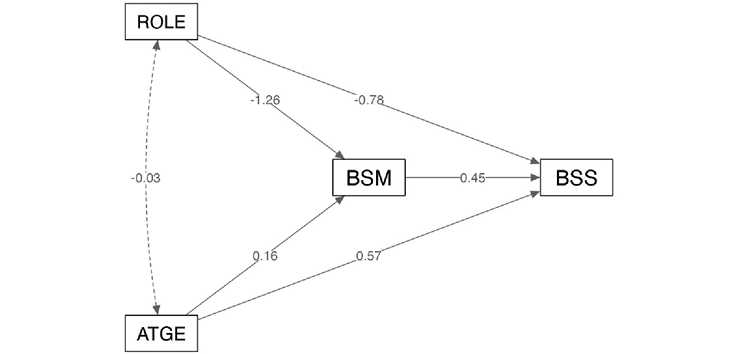
Mediation model. Direct and indirect effects of ATGE on BSS through BSM, controlling for teaching role.
Discussion
This study examined how teachers’ attitudes toward gifted education (ATGE) relate to belief in school meritocracy (BSM) and endorsement of school selection (BSS). First, regarding differences by teaching role, no significant differences emerged in ATGE levels between curricular and support teachers, consistent with generally positive attitudes reported in the literature (Sambuis & Bourdin, 2025). In contrast, curricular teachers reported higher levels of BSM and BSS. This pattern is consistent with previous findings suggesting that actors involved in evaluative processes tend to endorse meritocratic principles more strongly (Batruch, Autin & Butera, 2019; Wiederkehr et al., 2015). Support teachers showed lower endorsement, aligning with research on educators working in disability-related contexts (Khamzina et al., 2021; Stanczak et al., 2024). The absence of differences in ATGE, combined with differences in BSM and BSS, suggests that support for gifted education does not necessarily imply endorsement of meritocratic beliefs, with ideological orientations varying across professional roles. Second, correlational analyses provide further insight into the relationships among the main variables. ATGE was weakly associated with BSM, indicating that these constructs are related but not overlapping. At the same time, both ATGE and BSM were more strongly associated with BSS, suggesting that endorsement of school selection may be more closely linked to broader ideological orientations (Darnon et al., 2018). Consistent with prior research, belief in school meritocracy was associated with the legitimation of inequality (Batruch, Autin & Butera, 2019; Darnon et al., 2018; Darnon et al., 2023). Third, the mediation analysis showed that BSM partially mediated the relationship between ATGE and BSS. The indirect effect, although modest in magnitude, was significant. This result is in line with the idea that meritocratic beliefs may channel support for gifted education into endorsement of selective practices, in line with system-justifying frameworks (Batruch, Autin & Butera, 2019; Darnon et al., 2018; Wiederkehr et al., 2015). Importantly, the teaching role was included as a covariate and was significantly associated with both BSM and BSS, indicating that differences between curricular and support teachers persist within the model. However, the inclusion of role did not alter the overall pattern of relationships among the main variables. The significant direct effect of ATGE on BSS further indicates that favorable attitudes toward gifted education are associated with support for school selection beyond the mediated pathway of meritocratic beliefs. Teachers endorsing gifted education tend to support ability-based differentiation, particularly when it is not perceived as elitist (Akgül, 2021; Cross, Cross & O’Reilly, 2018; Lassig, 2009; Mullen & Jung, 2019).
Sambuis and Bourdin’s (2025) systematic review highlights that teachers often resist interventions involving the removal of students from regular classrooms, suggesting a tension between recognizing exceptional needs and maintaining inclusive structures. One possible interpretation is that the direct effect reflects support for within-classroom differentiation, although this aspect was not directly assessed in the present study. The persistence of the direct effect suggests the presence of additional mechanisms beyond meritocratic beliefs. Sambuis and Bourdin (2025) identified personal interactions and teacher self-efficacy as robust predictors, indicating that support for selection may also be shaped by experiential and pragmatic factors. Future research should investigate self-efficacy, exposure, and professional identity. Finally, when considered in relation to the inclusion/SEN literature, the present findings point to a potential asymmetry. Previous studies have shown that meritocratic beliefs are negatively associated with inclusive education for students with disabilities (Khamzina et al., 2021; Stanczak et al., 2024).
In contrast, the present results indicate that meritocratic beliefs are positively associated with support for differentiation in the context of gifted education. Taken together, these findings suggest that meritocratic beliefs may be differentially associated with educational practices depending on the target group. From a practical perspective, invoking meritocratic principles may mobilize support for gifted education but also carries potential risks, as it may reinforce hierarchical views privileging excellence over equity. Teacher education should therefore address the ideological dimensions underlying educational beliefs. Professional development should strengthen teachers’ confidence in differentiation and promote engagement with gifted learners, while alternative framings emphasizing diversity and collective responsibility may help reconcile excellence with inclusion (Elias et al., 2025; Lo, Lin-Yang & Chrostowski, 2022). Given the documented resistance to segregation (Sambuis & Bourdin, 2025), particular emphasis should be placed on within-classroom differentiation.
Limitations include cross-sectional data precluding causality. The modest indirect effect indicates other mechanisms. Sambuis and Bourdin (2025) identified self-efficacy and interactions; investigate alongside essentialist beliefs and contextual variables. Attitudes and beliefs are only one of several factors shaping teaching practice (Malhotra & Owston, 2024; Shahali & Halim, 2023), and self-reports do not capture actual behavior. Given attitudes toward specific interventions differ (Sambuis & Bourdin, 2025), examine translation into practices. Italian sample may differ from other systems. Measures assessed general orientations not specific conceptualizations. Given contemporary models emphasize dynamic conceptions (Subotnik et al., 2023; Ziegler & Phillipson, 2012) and attitudes vary by intervention (Sambuis & Bourdin, 2025), examine whether developmental conceptions show different patterns.
Teachers’ gifted attitudes positively associate with meritocracy and selection, with meritocracy as a partial mediator. While gifted support is shared, ideological beliefs diverge between roles. Results illuminate asymmetry: the same system facilitating gifted support undermines inclusive education. However, conditional support — positive toward needs, resistant toward segregation (Sambuis & Bourdin, 2025) — suggests reconciliation pathways. Reconciliation requires reconsideration of ideological foundations. Professional development should prioritize self-efficacy and interaction opportunities (Sambuis & Bourdin, 2025). Only by transforming belief systems while developing competencies can systems honor excellence and equity.
Conclusion
This study demonstrates that teachers’ attitudes toward gifted education are positively associated with both belief in school meritocracy and endorsement of the selective function of schooling, with meritocratic beliefs serving as a partial mediator of this relationship. The findings reveal that while support for gifted education is widely shared among teachers regardless of professional role, ideological beliefs about meritocracy and selection diverge systematically between curricular and support teachers, reflecting their differential positioning within evaluative and equity-oriented institutional functions.
Importantly, the results illuminate a fundamental asymmetry in how meritocratic ideology operates across different student populations: the same belief system that facilitates support for gifted education simultaneously undermines support for inclusive education for students with disabilities. However, recent systematic evidence (Sambuis & Bourdin, 2025) reveals that teachers’ support for gifted education is itself conditional and nuanced — while generally positive toward meeting gifted students’ needs, teachers express resistance toward pedagogical interventions that remove students from regular classrooms. This suggests that efforts to promote both excellence and equity in education will remain in tension as long as meritocratic assumptions remain the dominant framework for understanding educational differentiation, but also that pathways toward reconciliation may exist through differentiation strategies that maintain inclusive structures.
Moving forward, reconciling support for gifted students with commitment to inclusive education will require not merely technical refinements to identification or instructional practices, but fundamental reconsideration of the ideological foundations that shape how teachers understand talent, fairness, and the purpose of schooling. Professional development should prioritize building teacher self-efficacy in implementing differentiation strategies and creating opportunities for meaningful interaction with gifted learners — factors identified as robust predictors of positive attitudes (Sambuis & Bourdin, 2025). Only by critically examining and potentially transforming these deep-seated belief systems, while simultaneously developing teachers’ practical competencies in within-classroom differentiation, can educational systems hope to develop coherent approaches that honor both excellence and equity.
References
Akgül G. (2021), Teachers’ metaphors and views about gifted students and their education, «Gifted Education International», vol. 37, n. 3, pp. 273-289.
Antoun M., Kronborg L. e Plunkett M. (2020), Investigating Lebanese primary school teachers’ perceptions of gifted and highly able students, «Gifted and Talented International», vol. 35, n. 1, pp. 39-57.
Autin F., Batruch A. e Butera F. (2015), Social justice in education: How the function of selection in educational institutions predicts support for (non)egalitarian assessment practices, «Frontiers in Psychology», vol. 6.
Ayık Z., Çetin G. e Usta M. (2025), Sustained primary teacher provision for the gifted: The influence of gifted conceptions on nomination and differentiation, «BMC Psychology», vol. 13.
Batruch A., Autin F. e Butera F. (2019), The paradoxical role of meritocratic selection in the perpetuation of social inequalities at school. In J. Jetten e K. Peters (a cura di), The social psychology of inequality, Cham, Springer International Publishing, pp. 123-137.
Batruch A., Jetten J., Van de Werfhorst H., Darnon C. e Butera F. (2023), Belief in school meritocracy and the legitimization of social and income inequality, «Social Psychological and Personality Science», vol. 14, n. 5, pp. 621-635.
Borland J.H. (2005), Gifted education without gifted children: The case for no conception of giftedness. In R.J. Sternberg e J.E. Davidson (a cura di), Conceptions of giftedness, Cambridge, Cambridge University Press, pp. 1-19.
Borland J.H. (2021), The trouble with conceptions of giftedness. In R.J. Sternberg e D. Ambrose (a cura di), Conceptions of giftedness and talent, Cham, Palgrave Macmillan, pp. 37-49.
Buchner T., Shevlin M., Donovan M., Gercke M., Goll H., Šiška J., Janyšková K., Smogorzewska J., Szumski G., Vlachou A., Demo H., Feyerer E. e Corby D. (2021), Same progress for all? Inclusive education, the United Nations Convention on the Rights of Persons with Disabilities and students with intellectual disability in European countries, «Journal of Policy and Practice in Intellectual Disabilities», vol. 18, n. 1, pp. 7-22.
Cross T.L., Cross J.R. e O’Reilly C. (2018), Attitudes about gifted education among Irish educators, «High Ability Studies», vol. 29, n. 2, pp. 169-189.
Darnon C., Smeding A. e Redersdorff S. (2018), Belief in school meritocracy as an ideological barrier to the promotion of equality, «European Journal of Social Psychology», vol. 48, n. 4, pp. 523-534.
Darnon C., Wiederkehr V., Dompnier B. e Martinot D. (2018), «Where there is a will, there is a way»: Belief in school meritocracy and the social-class achievement gap, «British Journal of Social Psychology», vol. 57, n. 1, pp. 250-262.
Darnon C., Jury M., Goudeau S. e Portex M. (2023), Competitive and cooperative practices in education: How teachers’ beliefs in school meritocracy are related to their daily practices with students, «Social Psychology of Education», vol. 26, pp. 1789-1805.
De Beco G. (2018), The right to inclusive education: Why is there so much opposition to its implementation?, «International Journal of Law in Context», vol. 14, n. 3, pp. 396-415.
Elias M.J., Marsili F., Fullmer L., Morganti A. e Bruno E. (2025), The social-emotional competencies of gifted children must be intentionally developed, ideally in inclusive education contexts, «Gifted Education International», vol. 41, n. 1, pp. 57-75.
Florian L. (2019), On the necessary co-existence of special and inclusive education, «International Journal of Inclusive Education», vol. 23, nn. 7-8, pp. 691-704.
Gagné F. (2018), Attitudes toward gifted education: Retrospective and prospective update, «Psychological Test and Assessment Modeling», vol. 60, n. 4, pp. 403-428.
Gagné F. e Nadeau L. (1985), Dimensions of attitudes toward giftedness. In A.H. Roldan (a cura di), Gifted and talented children, youth and adult: Their social perspective and culture, Brisbane, Trillium Press, pp. 148-170.
Giza T. (2022), Theoretical assumptions and validation of a scale for international comparative research on teachers’ attitudes toward educating talented students, «Multidisciplinary Journal of School Education», vol. 11, n. 2(22), pp. 139-161.
Göransson K. e Nilholm C. (2014), Conceptual diversities and empirical shortcomings: A critical analysis of research on inclusive education, «European Journal of Special Needs Education», vol. 29, n. 3, pp. 265-280.
Haug P. (2017), Understanding inclusive education: Ideals and reality, «Scandinavian Journal of Disability Research», vol. 19, n. 3, pp. 206-217.
Jung J.Y. e Lee J. (2024), Teacher attitudes toward gifted students and gifted education: The typologies of attitudes and their predictors, «Exceptional Children», vol. 91, n. 1, pp. 74-92.
Khamzina K., Jury M., Ducreux E. e Desombre C. (2021), The conflict between inclusive education and the selection function of schools in the minds of French teachers, «Teaching and Teacher Education», vol. 106.
Laine S., Hotulainen R. e Tirri K. (2019), Finnish elementary school teachers’ attitudes toward gifted education, «Roeper Review», vol. 41, n. 2, pp. 76-87.
Lassig C. (2009), Teachers’ attitudes towards the gifted: The importance of professional development and school culture, «Australasian Journal of Gifted Education», vol. 18, n. 2, pp. 32-42.
Lo C.O., Lin-Yang R.C. e Chrostowski M. (2022), Giftedness as a framework of inclusive education, «Gifted Education International», vol. 38, n. 3, pp. 431-437.
Malhotra T. e Owston R. (2024), Do instructor beliefs and attitudes matter? Understanding associations between beliefs, attitudes, and practices, «Australasian Journal of Educational Technology», vol. 40, n. 5, pp. 65-83.
Marsili F. e Mirandi M. (2025), Teachers’ attitudes towards gifted students: An evaluation of Italian teachers’ perspectives, «Educrazia», vol. 1, n. 1, pp. 285-298.
Martschenko D.O. (2023), Normalizing race in (gifted) education: Genomics and spaces of White exceptionalism, «Critical Studies in Education», vol. 64, n. 1, pp. 67-83.
Mazzoli Smith L. (2014), Giftedness and globalisation: The challenge of cultural diversity for gifted education programmes in a neoliberal educational marketplace, «Gifted Education International», vol. 30, n. 3, pp. 197-211.
Mazzoli Smith L. e Campbell R.J. (2016), So-called giftedness and teacher education: Issues of equity and inclusion, «Teachers and Teaching», vol. 22, n. 2, pp. 1-13.
McCoach D.B. e Siegle D. (2007), What predicts teachers’ attitudes toward the gifted?, «Gifted Child Quarterly», vol. 51, n. 3, pp. 246-255.
Mullen C. e Jung J.Y. (2019), Teachers’ attitudes towards gifted programs and provisions: An Australian study of primary and secondary school teachers, «Australasian Journal of Gifted Education», vol. 28, n. 1, pp. 24-35.
Polyzopoulou K., Kokaridas D., Patsiaouras A. e Gari A. (2014), Teachers’ perceptions toward education of gifted children in Greek educational settings, «Journal of Physical Education and Sport», vol. 14, n. 2, pp. 211-221.
Radulović B. (2022), Teachers’ opinions about elitism in gifted education, «South African Journal of Education», vol. 42, n. si1, pp. 1-9.
Sambuis S. e Bourdin B. (2025), Teachers’ attitude towards gifted students and their education: A systematic review, «Journal for the Education of the Gifted», vol. 48, n. 1, pp. 48-81.
Shahali E.H. e Halim L. (2023), The influence of science teachers’ beliefs, attitudes, self-efficacy and school context on integrated STEM teaching practices, «International Journal of Science and Mathematics Education», vol. 22, pp. 787-807.
Stanczak A., Jury M., Aelenei C., Pironom J., Toczek-Capelle M.-C. e Rohmer O. (2024), Special education and meritocratic inclusion, «Educational Policy», vol. 38, n. 1, pp. 85-103.
Subotnik R.F., Olszewski-Kubilius P., Corwith S., Calvert E. e Worrell F.C. (2023), Transforming gifted education in schools: Practical applications of a comprehensive framework for developing academic talent, «Education Sciences», vol. 13, n. 7.
UNESCO (1990), World declaration on education for all: Framework for action to meet basic learning needs: Jomtien, Thailand 5-9 March 1990, Paris, UNESCO.
UNESCO (1994), The Salamanca statement and framework for action on special needs education, Paris, UNESCO.
United Nations (2006), Convention on the rights of persons with disabilities, New York, NY, United Nations.
Wiederkehr V., Bonnot V., Krauth-Gruber S. e Darnon C. (2015), Belief in school meritocracy as a system-justifying tool for low status students, «Frontiers in Psychology», vol. 6.
Worrell F.C. e Dixson D.D. (2022), Achieving equity in gifted education: Ideas and issues, «Gifted Child Quarterly», vol. 66, n. 2, pp. 79-81.
Ziegler A. e Phillipson S.N. (2012), Towards a systemic theory of gifted education, «High Ability Studies», vol. 23, n. 1, pp. 3-30.
-
1 Il contributo è il frutto del lavoro congiunto dei tre autori. Sono da attribuirsi a Francesco Marsili i paragrafi Introduction, Objectives and hypotheses e Discussion; a Maria Mirandi i paragrafi Method e Results; ad Annalisa Morganti il paragrafo Conclusion.
-
2 Ricercatore Post-Doc, Università degli Studi di Perugia.
-
3 Ricercatrice, Istituto Universitario Sophia, Firenze.
-
4 Professoressa Associata, Università degli Studi di Perugia.
-
5 Ricercatore Post-Doc, Università degli Studi di Perugia.
-
6 Ricercatrice, Istituto Universitario Sophia, Firenze.
-
7 Professoressa Associata, Università degli Studi di Perugia.
Vol. 25, Issue 3, November 2026